
How to choose the right dashcam
Why a dashcam can be useful on Indian roads
Busy junctions, mixed traffic, changing light and long highway drives can make it difficult to recall exactly what happened during an incident. A correctly positioned dashcam provides a time-stamped visual record that may help you explain events to an insurer, service centre or relevant authority.
A dashcam does not prevent a collision and footage does not guarantee a legal or insurance outcome. Drive safely, preserve the original file when an incident occurs and follow requests from the appropriate authority or insurer.
Resolution, night recording and viewing angle
Full HD is a sensible starting point, while higher resolution can preserve more detail when lighting and camera placement are good. Resolution alone is not enough: sensor quality, image processing, windscreen reflections and motion all affect whether a number plate is readable.
For night use, look for a dedicated low-light mode and review real sample footage where possible. A moderately wide view helps cover adjacent lanes, but an extremely wide lens can make vehicles and number plates appear smaller near the edges.
- Prioritise clear moving footage over a large resolution claim.
- Keep the windscreen and camera lens clean to reduce glare and softness.
- Check daytime and night samples recorded in conditions similar to your driving.
Storage and loop recording
Dashcams continuously create large video files. Loop recording automatically overwrites the oldest ordinary clips when the card becomes full, while an impact sensor may lock an emergency clip so it is not immediately overwritten.
Use the capacity and card type recommended by the camera manufacturer. A high-endurance microSD card is generally better suited to repeated recording than a basic card. Format it as instructed, check recordings periodically and copy important clips promptly.
Battery versus supercapacitor
A built-in battery can provide brief backup power, but lithium batteries may be more sensitive to the high temperatures reached inside a parked car. A supercapacitor is designed for short power continuity rather than extended recording and is often preferred for heat tolerance.
Whichever design you choose, confirm the manufacturer's operating-temperature guidance and never assume parking surveillance works without a compatible power source or hardwire kit.
Installation considerations
Mount the camera high on the windscreen—commonly behind or close to the rear-view mirror—without obstructing the driver's view. Route the power cable securely so it cannot interfere with steering, pedals, airbags or visibility.
A standard 12V socket installation is easier to remove. Parking mode may require a compatible hardwire kit and professional installation to protect the vehicle battery and electrical system. Check your vehicle warranty, local requirements and the dashcam manual before hardwiring.
Quick comparison
| Product | Our pick for | Marketplace check | Details |
|---|---|---|---|
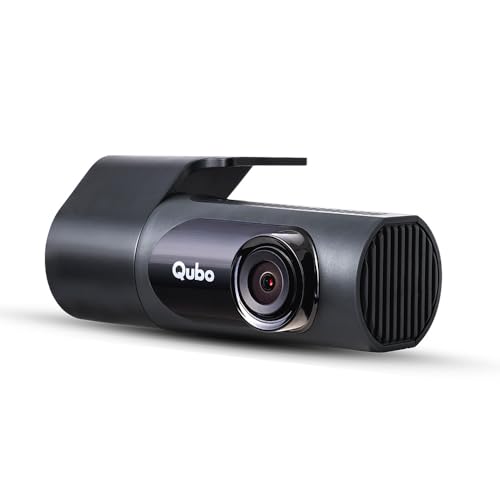 Qubo Dashcam Pro XQubo | Our current verified pick | 2,353 ratings | View details → |
Ratings are marketplace snapshots and can change. Check the latest price, seller, variant, delivery and reviews on Amazon before buying.
Which one should you choose?
Our current verified pick
Qubo Dashcam Pro X
A compact made-for-India option with Full HD+ recording, low-light support, Wi-Fi app access, loop recording and automatic protection for emergency clips.
- Full HD+ dashboard recording
- NightPulse low-light vision
- Wi-Fi app access
A practical buying checklist
- 01Choose recording quality based on real sample footage, not resolution alone.
- 02Confirm supported microSD capacity and use a card designed for repeated video recording.
- 03Check whether parking mode needs a separate hardwire kit or power supply.
- 04Place and cable the camera without blocking vision or interfering with airbags and controls.
- 05Review footage regularly so you know the camera, card, date and time settings are working.
Helpful answers
Is a dashcam useful in India?
It can provide a useful video record of road events and journeys. It does not prevent accidents or guarantee acceptance by an insurer, police or court, so preserve original footage and follow the relevant process after an incident.
What dashcam resolution should I choose?
Full HD is a practical minimum for many drivers. Higher resolution may capture more detail, but sensor quality, motion, lighting, lens cleanliness and placement also determine whether footage is useful.
Will a dashcam record while the car is parked?
Only if the model supports parking mode and receives compatible power while the ignition is off. This may require a separate hardwire kit or external power solution.
How much storage does a dashcam need?
It depends on resolution, frame rate and driving time. Follow the manufacturer's supported-capacity guidance and prefer a high-endurance microSD card intended for continuous recording.
Is a battery or supercapacitor dashcam better?
Supercapacitors are often chosen for better heat tolerance, while batteries can provide brief backup power. Check the exact model's operating-temperature rating and intended power behaviour.
Is dashcam installation difficult?
A plug-in front camera is usually straightforward, but tidy cable routing and hardwired parking mode can be more involved. Professional installation is sensible if cables may pass near airbags or connect to the fuse box.